Kaiju usually begins with a very simple spectacle: something large emerges from the sea, forest, space, or underground, and human cities suddenly become fragile decorations. Skyscrapers crumble, tanks seem like toys, sirens wail, and the camera looks up at a person from below, as if to remind: we are not always the main characters in this story.
But kaiju is not just a "big monster." In the best works of the genre, the creature the size of a city block acts as a living metaphor. It can represent the fear of the atomic bomb, ecological disaster, war, urbanization, trauma, bureaucracy, or simply a child's delight at seeing a giant turtle and a dragon battle on screen. It is in this strange mix of catastrophe, myth, and attraction that kaiju have become one of the most recognizable images in Japanese and global pop culture.
What is Kaiju
The word "kaiju" comes from the Japanese kaijū - 怪獣. It is often translated as "strange beast," "mysterious creature," or "monster." In modern pop culture, it primarily refers to large fantastical creatures that appear in films, series, manga, anime, comics, and games. Most often, these are beings of enormous size capable of destroying cities, battling armies, other monsters, or giant robots.
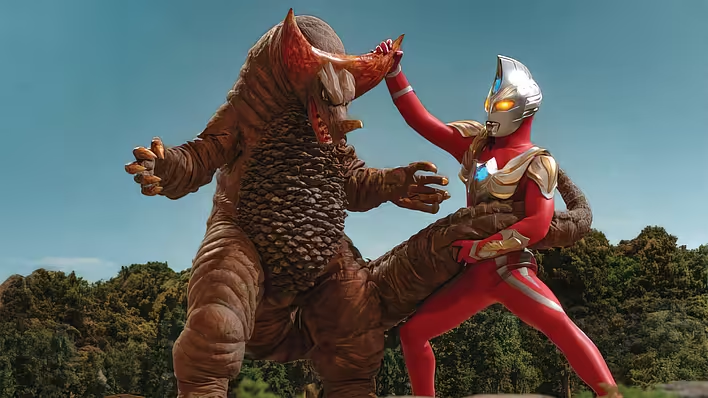
At the same time, kaiju do not necessarily have to be evil. Godzilla has, at different times, embodied both catastrophe and the protector of Earth. Gamera started as a destructive force but later became almost a knight for children. The monsters from Ultraman are often the enemies of the week, but sometimes they are driven by sorrow, experimentation, ecological mistakes, or alien tragedy. Kaiju can be predators, gods, mutants, bioweapons, ancient guardians, or simply creatures that humans cannot comprehend.
There is also the word daikaijū - "large kaiju" or "giant monster." This term well describes the classic image: a creature so large that its presence changes the scale of the entire world around it. A person next to a kaiju almost always appears not as a hero but as a witness.
Where the Term Came From
Before kaiju became a genre term for cinema, the Japanese language already had a rich vocabulary for strange creatures, spirits, and monsters. In folklore, there were yokai - supernatural beings that could be terrifying, funny, mundane, or morally ambiguous. Kaiju is not simply another word for yokai, but both concepts exist in the same cultural field: where the boundary between the natural and the unnatural has never been absolutely firm.
In the modern era, the word kaijū began to be used more broadly: to describe unusual animals, prehistoric creatures, monsters from adventure literature and science fiction. The Japanese imagination was influenced by translations of Western novels, paleontology, newspaper sensations, illustrations of dinosaurs, and early films about lost worlds. Thus, kaiju as an image did not arise from a vacuum: it stands at the intersection of folklore, science, the colonial era, and modern mass culture.
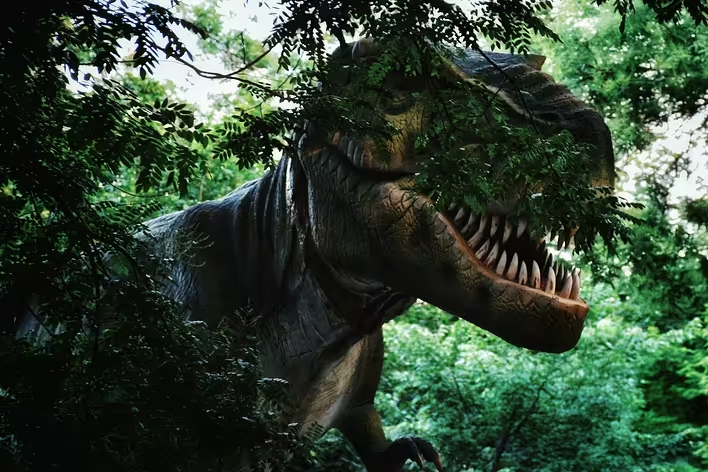
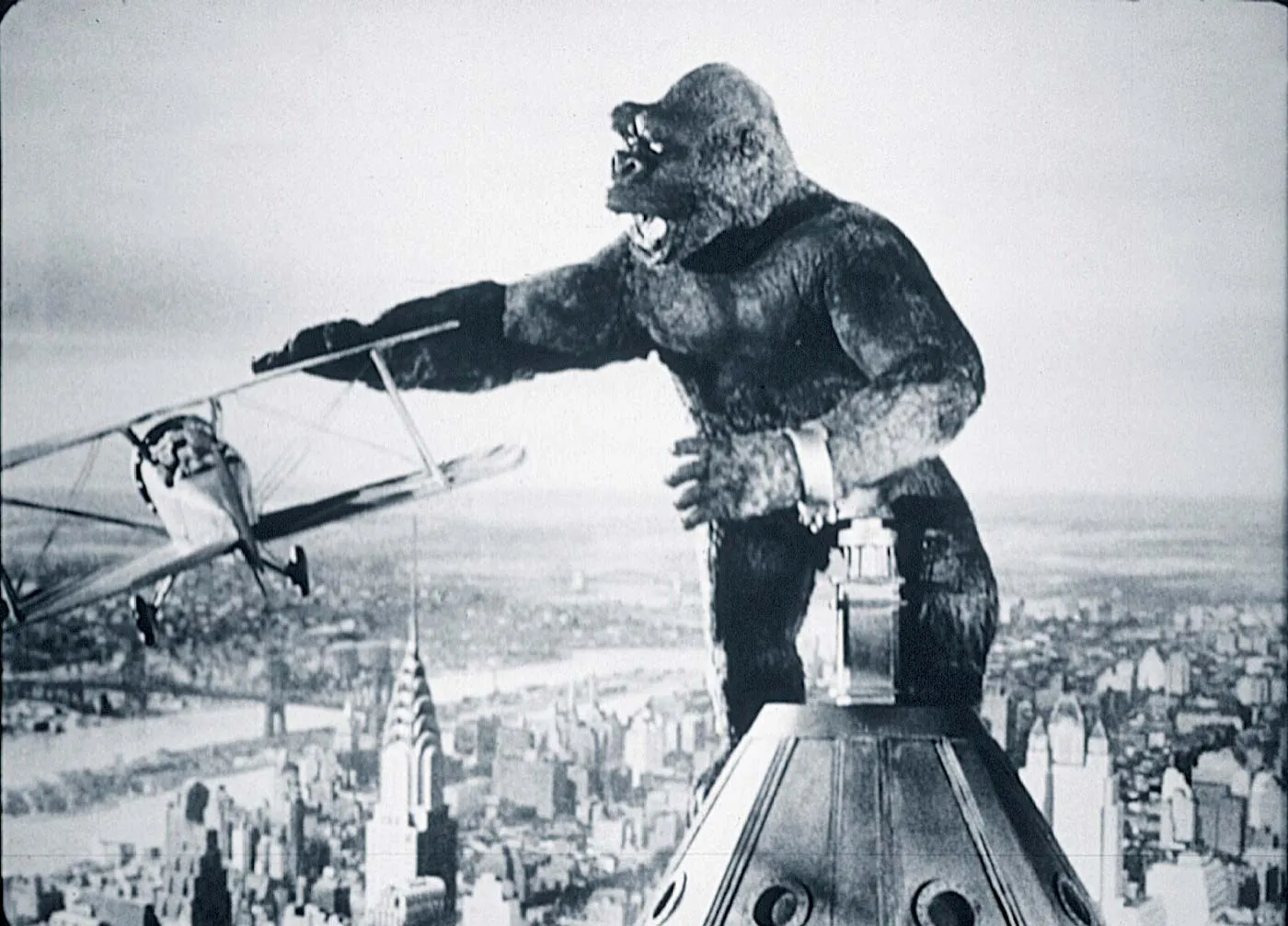
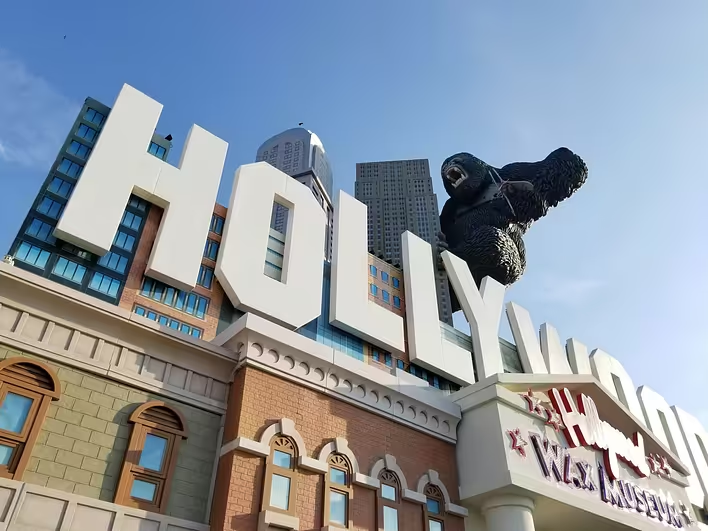
Before Japan gave the world Godzilla, there were already significant predecessors in the West. "The Lost World" from 1925 featured dinosaurs breaking into a modern city. "King Kong" from 1933 made the giant creature a tragic movie star: not just a monster, but a character to be feared and pitied. "The Beast from 20,000 Fathoms" from 1953 added atomic anxiety: a prehistoric monster awakens due to nuclear tests.
The Japanese kaiju film took these impulses and transformed them into something its own. The key was not only the size of the creature but also the method of presentation: an actor in a suit, a miniature city, smoke, models of buildings, the illusion of weight. This is no longer just a monster in the frame. It is a whole world built to be destroyed.
Godzilla: The Monster After the Atomic Age
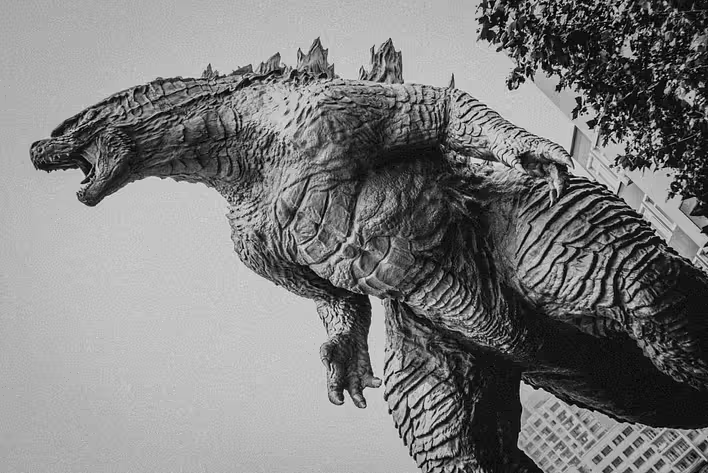
The modern canon of kaiju begins with the film "Godzilla" from 1954, directed by Ishirō Honda at Toho with special effects by Eiji Tsuburaya. This is important: the first Godzilla was not a frivolous monster movie. It was born in post-war Japan, in a country that remembered Hiroshima and Nagasaki, the American occupation, the censorship of the atomic bombing topic, and the fresh trauma of the incident with the fishing vessel Daigo Fukuryū Maru, which suffered from radioactive fallout after hydrogen bomb tests at Bikini Atoll.
In this context, Godzilla does not simply emerge from the sea. He brings ashore the fear that people tried to label as progress, military power, or the politics of great powers. His atomic breath is not a magical special effect but an image of a weapon that humanity created but did not learn to control morally. Tokyo in ruins does not look like an attraction but a repetition of collective trauma.
That is why Godzilla became more than just a monster. It created a template: kaiju can be a catastrophe with a face. In this genre, fear takes on a body, weight, voice, and direction of movement. It walks down the street, steps on wires, scatters subway cars, and people can finally see what is usually too big to comprehend.
Tokusatsu: The Art of Miniatures and Costumes
Kaiju cannot be completely separated from tokusatsu - Japanese cinema and television with special effects. For classic films, this meant not just "a person in a monster suit," but a whole aesthetic. Miniature cities were built with such love for detail that their destruction became almost a ritual. Smoke, water, sparks, explosions, wires, puppets, mechanical heads and tails - everything worked to create a sense of scale.
In Western cinema, stop-motion animation long dominated, particularly in the works of Ray Harryhausen. The Japanese tradition took a different path: costume, physical presence, slow movement, body weight. This gave rise to a special corporeality of kaiju. Even when the viewer understands that there is an actor in a suit before them, they still feel the materiality of the scene. The building really breaks. The model really burns. The monster is not drawn somewhere far away - it stands among objects that can be touched.
This artisanal nature of the genre has become part of its charm. Kaiju films are often loved not in spite of their artificiality, but precisely because of it. You can see human hands: sculptors, pyrotechnicians, operators, actors who move for hours in heavy suits. And because of this, the fantasy looks almost theatrical.
Not Just Godzilla: The Pantheon of Monsters
After the success of Godzilla, the genre quickly expanded. Toho created a whole pantheon of kaiju: Rodan, Mothra, Anguirus, King Ghidorah, Mechagodzilla. Each had its own silhouette, character, and function. Mothra brought almost fairy-tale softness and the image of a protective deity to the genre. King Ghidorah became a cosmic dragon, a pure threat from another world. Mechagodzilla added a technological doppelgänger: the fear that human weapons could replicate a monster and become equally dangerous.
In 1965, Daiei studio responded with its own hero - Gamera, a giant turtle that flies, breathes fire, and gradually transforms into a protector of children. If Godzilla often leans towards the image of the force of nature or atomic retribution, Gamera has a different emotional tone: it has more adventurous devotion, childlike faith, and strange tenderness. This is especially evident in later films, where Gamera is no longer just a monster but a guardian who pays for battles with its own body.
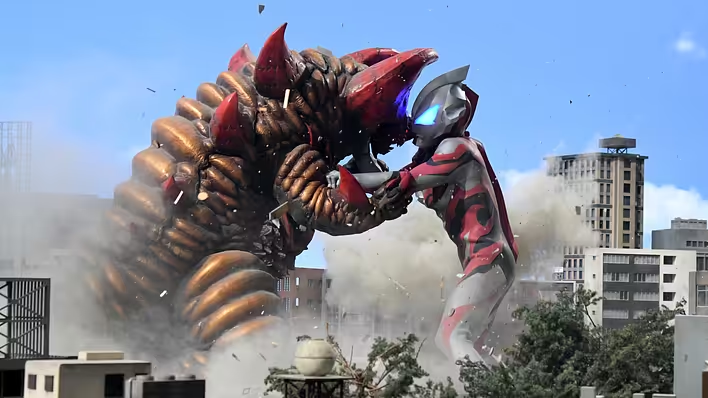
A separate branch is Ultraman, which started in 1966 after the series Ultra Q. Here, kaiju became part of the television rhythm: a new creature, a new threat, a new moral or fantastical situation appears each week. Ultraman is important because it combined monsters with the superhero tokusatsu format. The giant hero fights giant creatures, and the child audience receives not only the fear of destruction but also the joy of ritual: transformation, pose, battle, victory, next week.
Kaiju as a Mirror of Fears
The most interesting thing about kaiju is that they constantly change along with the fears of the era. In the 1950s, it was atomic anxiety and post-war trauma. In the 1960s and 1970s - the space race, alien threats, industrialization, pollution, the children's television boom. Later, the genre began to address biotechnology, government inefficiency, media, terrorism, climate catastrophe, and global politics.
"Shin Godzilla" from 2016 depicted the monster almost as a natural disaster passing through a bureaucratic system. This film is not only about the creature but also about offices, protocols, meetings, and the slowness of government response. The monster grows, changes, adapts, while people try to catch up with reality through papers and positions. Here, kaiju becomes an image of a crisis in which the old language of governance appears helpless.
"Godzilla: Minus One" from 2023 returned the monster to post-war pain but emphasized not only national trauma but also personal survival. In this film, kaiju works as a form of guilt, fear, and an unfinished war that literally emerges from the sea and forces people to decide again what they want to live for.
Kaiju are therefore so resilient: they can be reimagined every time. One monster can be a bomb, a tsunami, a virus, a corporation, a state, a god, or a child of nature that humans have awakened too loudly.
Pacific Rim
Pacific Rim: When Monsters Are Answered by Robots
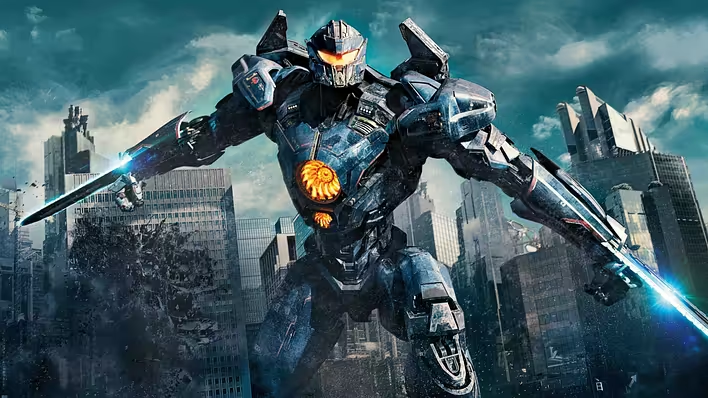
"Pacific Rim" by Guillermo del Toro from 2013 does not hide its love for kaiju but does not directly copy Japanese classics. In this world, kaiju come from an interdimensional rift at the bottom of the Pacific Ocean, and humans create Jaegers - giant robots controlled by two pilots through neural connection. The idea is simple, almost childlike: if monsters the size of cities come against us, we will also build something the size of a city.
But the strength of "Pacific Rim" lies not only in the battles. The film makes kaiju a language of collective action. One pilot cannot bear the load, so two are needed, who trust each other and share memories. Humanity survives not through a lone hero but through synchronization. Against the backdrop of monsters, this sounds almost naive, but therein lies the charm: kaiju here is not just a threat but a reason to imagine a world where people must finally come to an agreement.
Anime, Manga, and Games: Kaiju After the Cinema
Kaiju have long gone beyond cinema. In anime and manga, they often become a way to talk about the body, militarism, teenage anxiety, and the boundaries of humanity. "Neon Genesis Evangelion" is not a classic kaiju work in the narrow sense, but its Angels, giant biomechanical Evas, and urban battles clearly converse with the kaiju and tokusatsu tradition. Here, the monster is no longer just an external threat: it enters into psychology, religious symbolism, and the fear of growing up.
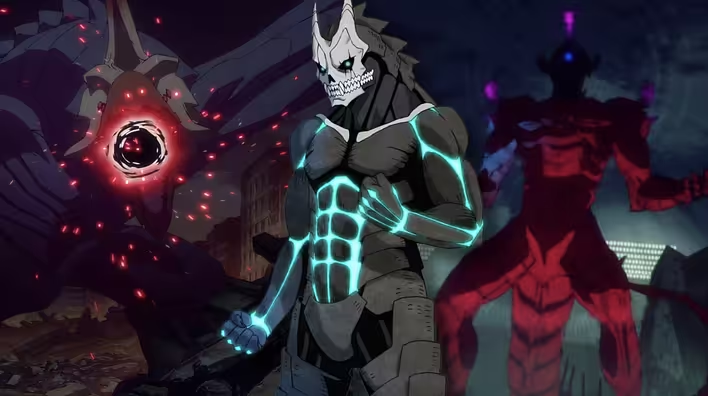
"Kaiju No. 8" makes another modern twist. In this world, kaiju are almost a regular problem, and their bodies after battles are cleaned up by special services. The main character is not a young chosen one but an adult man who works in a monster disposal team and gains kaiju power himself. This is very indicative of newer pop culture: the genre is interested not only in the moment of attack but also in the infrastructure that follows it. Who cleans up the debris? Who cuts up the monster's body? Who lives in a world where the extraordinary has become a job?
In games, kaiju also feel natural, as the genre seems to demand interactivity: one wants either to flee from the giant or to become one themselves. The arcade game Rampage allowed players to destroy cities from the monster's perspective. King of the Monsters, War of the Monsters, and GigaBash turn kaiju battles into a fun attraction, while the board game King of Tokyo turns monster fighting into a quick game about gambling, dice, and city control. City Shrouded in Shadow takes a different angle: the player does not control Godzilla or Ultraman but survives as an ordinary person while giants clash around.
аніме "Kaiju No. 8"
Why Kaiju Still Work
Kaiju endure for so long because they are both very simple and very flexible at the same time. The simplicity lies in the fact that the viewer does not need a long explanation of the stakes: if a creature the size of a district is heading towards a city, that’s a problem. The flexibility is that almost any meaning can lie behind this problem.
Kaiju provide a scale that everyday life lacks. They make the invisible visible. Radiation has no face - Godzilla does. Climate anxiety is vague - the monster from the sea is specific. Government slowness is abstract - a creature that changes faster than protocols is very convincing. Even a child's fear of the adult world takes shape in kaiju: big, loud, incomprehensible, but sometimes it can be defeated or at least understood.
There is another reason. Kaiju allow pop culture to be both serious and naive at the same time. The same genre can produce a grim anti-nuclear drama, a children's series with rubber suits, a Hollywood blockbuster, philosophical anime, and a game where monsters throw each other into buildings. This is not a contradiction but the main resource of the genre.
Kaiju are a great exaggeration that helps to tell the truth. Humanity loves to think of itself as the center of the world, but the genre repeatedly reduces us to the scale of figurines on a model. And it is there, among the sirens, debris, and shadows over the city, that a strange feeling arises: sometimes a monster is needed not to destroy the world but so we can finally see what this world is made of.