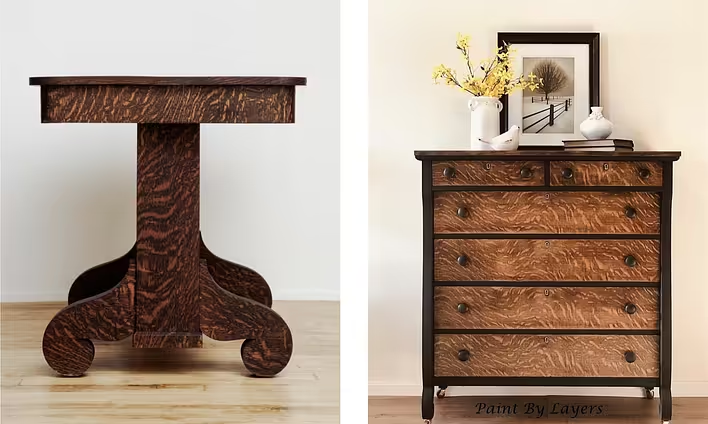
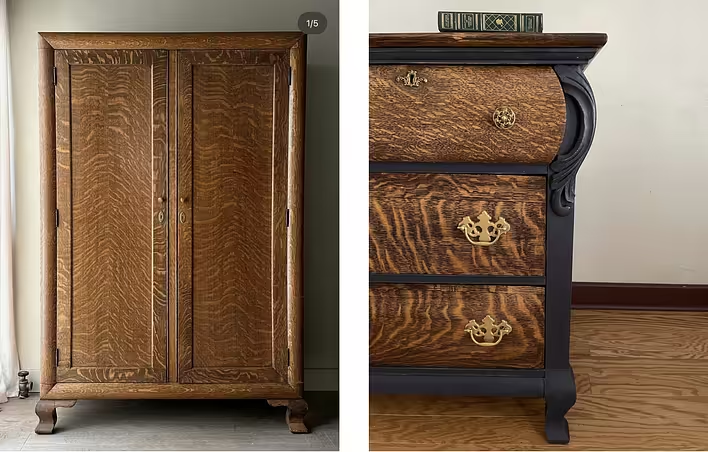
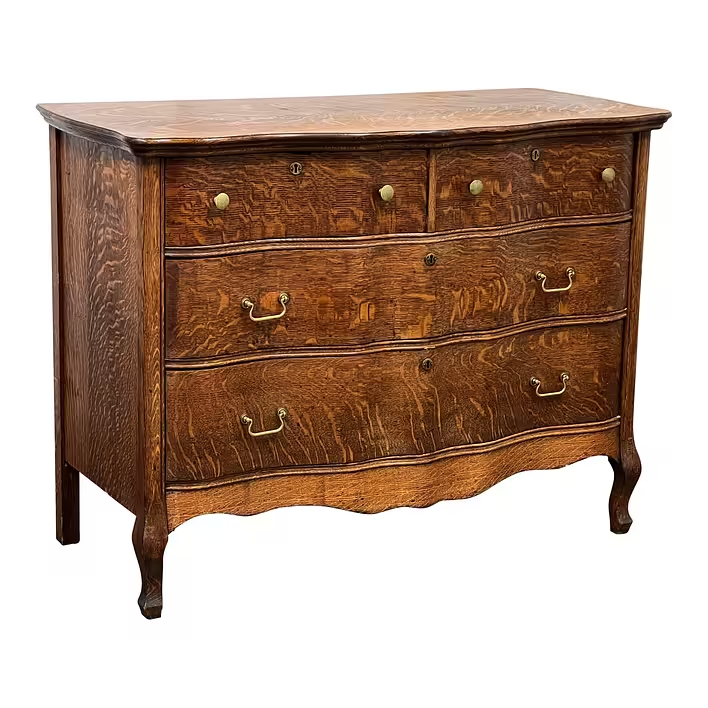
What is often called “tiger oak” (Eng. tiger oak) today is not actually a separate species of tree. It refers to a special wood pattern that arises from the specific sawing of oak and its natural structure. This effect — bright wavy or striped lines resembling a tiger's skin — made the material extremely popular in furniture production in the late 19th to early 20th century.
What is the “tiger” pattern
The basis of this effect is radial sawing (quarter sawn oak). When the trunk of the oak is cut at a certain angle to the growth rings, the medullary rays — natural structures that are almost invisible in plain sawing — become visible on the surface. These rays create the characteristic light “stripes” that contrast with the darker texture of the wood.
To enhance this pattern, the wood is often treated using the method of ammonia smoking: the oak is placed in an environment with ammonia vapors that react with the tannins. As a result, the wood darkens, and the contrast between the veins becomes more pronounced.
“Tiger oak” was particularly fashionable in furniture at the end of the 19th to the beginning of the 20th century when the natural beauty of materials and their texture were valued. Such oak was used to make buffets, dressers, cabinets, and tables. The furniture looked massive and solid, and the pattern itself became the main decorative feature.
In addition to aesthetics, radially sawn oak has practical advantages:
it is less prone to deformation;
it better withstands changes in humidity;
it has a more stable structure than oak with traditional sawing.
That is why such furniture lasts for decades.
Counterfeits and Imitations
The popularity of “tiger oak” has led to the emergence of numerous imitations. They existed as early as the 20th century and remain common today.
VeneerA thin layer of oak with a pronounced pattern is glued onto a cheaper base (pine or plywood). Externally, it looks convincing, but when damaged, a different material is visible beneath the layer.
Embossing and StainingA relief or pattern that imitates striped texture is applied to the surface. Stains and varnishes are often used to create contrast.
Laminate and PrintingIn modern furniture, laminated surfaces with printed patterns are often used. This is the cheapest option, which can be easily recognized upon close inspection.
The real material has depth: the pattern is not just on the surface but goes through the wood. On cuts and edges, the pattern continues. Imitations, however, only have a surface layer.
Moreover, natural oak is heavy, dense, and has a characteristic texture to the touch.
Today, interest in “tiger oak” is returning along with the trend for vintage and natural materials. Old furniture is actively restored, and modern manufacturers are again using radial sawing to achieve the characteristic pattern.
However, due to the complexity of processing and high cost, genuine “tiger oak” remains quite rare, so the market continues to be filled with imitations.