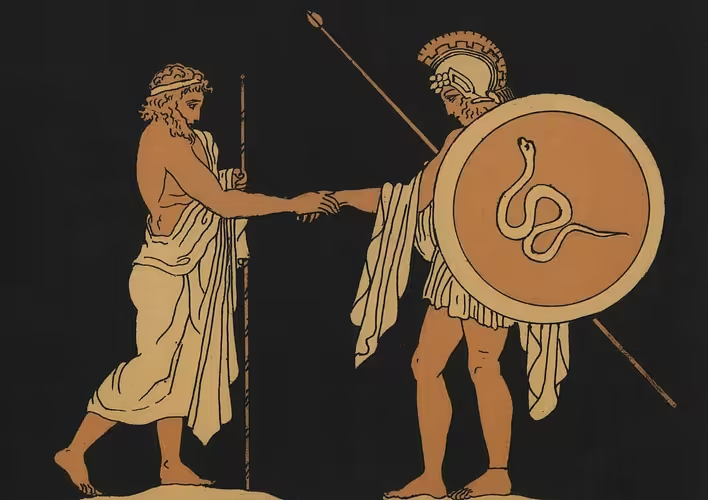
Myths are fascinating stories that take us back to distant times when the world was full of charms and mysteries. They have always held a special place in the culture of every nation, as a myth is not just a tale, but also a way to understand ourselves and the surrounding world. But what are myths really? How did they arise and what do they express? Let's figure it out!
What is a myth: definition and meaning
A myth is an ancient narrative that explains natural phenomena, the origin of the world, gods, or heroes. It is a kind of folklore literature that has been passed down orally from generation to generation. Myths reflect the worldview of ancient people, their ideas about good and evil, life and death.
The term “myth” comes from the Greek word “mythos,” which means “word,” “narrative.” So, what does the concept of myth mean? It is a way of transmitting knowledge and values that are important for society.
How did myths originate?
Myths originated in prehistoric times when people tried to explain incomprehensible natural phenomena. Without scientific knowledge, they created stories about gods and spirits that governed the world. For example, thunder and lightning could be explained as the anger of Zeus, the supreme god of the ancient Greeks.
Characteristics of myths
Myths have several characteristic features:
- Sacredness: Myths are often related to religious beliefs.
- Symbolism: The use of symbolic images to convey ideas.
- Collectivity: Created and transmitted within a community.
- Tradition: Passed down from generation to generation without changes.
Types of myths
There are different types of myths that can be classified by their themes:
- Cosmogonic: Narrate the creation of the world.
- Theogonic: Tell about the origin of the gods.
- Anthropogenic: Explain the origin of humanity.
- Eschatological: Dedicated to the end of the world or an era.
What do myths reflect?
Myths reflect deep psychological needs of people, their desire to find meaning in the chaos of the surrounding world. They express the fears and hopes of our ancestors, their desire to understand their place in the universe.
What does a myth tell?
A myth tells not only about a specific event or hero. It also conveys moral lessons and values. For example, the myth of Prometheus, who stole fire for people, symbolizes self-sacrifice for the common good.
What is mythology?
Mythology is a collection of myths of a certain culture or people. It is the foundation of many religious systems and cultural traditions. Mythology helps to understand the historical development of society and its worldview.
What kinds of myths are there?
In addition to traditional ancient myths, there are modern myths — popular stories or notions without factual basis. For example, myths about aliens or conspiracy theories.
Ultimately, we can say that myths are not just fabrications or fairy tales. They are an important part of our culture and help us better understand ourselves and our past. Whether it is an ancient legend or a modern myth, each such story has its significance and impacts our lives.
So, if you want to dive deeper into the world of antiquity and understand it better — turn to myths. They can reveal many interesting and unexpected things to you!